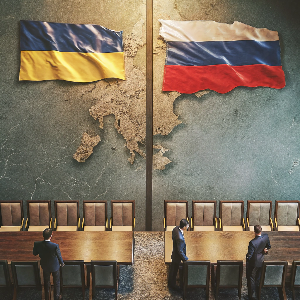
Negotiations or Their Imitation?
Prospects for Dialogue Between Ukraine and Russia
Increasing pressure on Russia from the United States, the EU, China, and many other countries, including its partners, is forcing Moscow to make certain compromises, in particular in terms of resuming direct negotiations with Ukraine. However, V. Putin does not give up his strategic goals for Ukraine. Therefore, Moscow will try to use the negotiations to impose its conditions for suspending the war on Ukraine. At the same time, Russia will not stop fighting in order to exert forceful pressure on Ukraine and seize as much Ukrainian territory as possible, causing maximum damage to Ukraine. Despite these intentions, the Kremlin will be forced to make concessions and at least demonstrate its readiness to end hostilities and sign a peace agreement. Otherwise, Russia will inevitably face a deep crisis in its economy. Ukraine will also have to make concessions, as in the current situation it will not be able to fully implement its goals. However, this will be an objective price to pay for restoring peace and obtaining reliable security guarantees.
May of this year will indeed be crucial in the development of the situation in the world and around Ukraine. At the moment, it concerns the launch of direct negotiations between Ukraine and Russia to end the war. As you know, the first round of dialogue took place on May 16 in Istanbul for the first time in three years of the war. At this, Moscow lifted the preconditions for the resumption of the dialogue, which were completely unacceptable to Ukraine. Of course, V. Putin has not abandoned his goals of destroying Ukraine as an independent state. This remains his geopolitical goal as part of his plans to revive Russia as a great world power. However, he is forced to change the methods of his actions, which now take the form of a full-scale war against Ukraine.
By the way, he himself has already admitted that this is a war, not a “special military operation”, as he had previously called it. And this is quite understandable, since Russia’s inability to achieve decisive success in some sort of “special military operation” is much more humiliating for it than in a real war. Besides, the term “war” actually legalizes Moscow’s aggressive goals of seizing five regions of Ukraine. That is why agreeing to start direct negotiations with Ukraine without its readiness to surrender was a rather difficult decision for Putin. Especially after he had refused to recognize Ukraine’s statehood and the legitimacy of its government. However, Putin and his environment did make concessions, or at least demonstrate them, hoping to stall for time and find a favorable way out of the situation they found themselves in. Moreover, the situation is indeed extremely difficult for the Kremlin and is determined by a number of internal and external factors that are virtually insurmountable in nature. They are well known, but it is worthwhile to dwell on them again.
Thus, at present, Russia has essentially lost the ability to continue the war as it was before. This is evidenced by the events at the front since the end of last year. As before, the Russian Armed Forces are actively storming Ukrainian positions on all major directions. However, their advances are minimal and are accompanied by excessive losses.
In some areas, the Ukrainian Armed Forces counterattack, thus improving their positions. This is quite natural, as Ukraine, with the help of its partners, is consistently strengthening its military capabilities. By the way, despite the claims of his “pro-Russian” policy, D. Trump not only continues to provide military and technical aid to Ukraine, but has also expanded its range by supplying spare parts for F-16 aircrafts.
At this, Russia cannot change these trends because it lacks the necessary forces and means. The reason is the critical aggravation of problems in the Russian economy, which can no longer withstand a war and cannot provide Moscow with the necessary financial resources or material and technical means (including a sufficient number of weapons) to achieve the desired success.
Russia is also unable to cope with these problems, at least in the short term. According to most unbiased estimates, it can only survive for a certain period of time by using harsh methods of action such as “military communism” introduced by the Bolsheviks during the Russian Civil War in 1917–1922. This would allow Moscow to maintain the current intensity of hostilities at the front until approximately the end of this year. However, any powerful offensives with a breakthrough of the front line, which some experts expect, are out of the question. Russia is only replenishing its losses during the fighting, but it does not have the strength for anything else. Adequate assessments on this matter are widely available and there is no point in repeating them.
Everything that has been said is the best-case scenario for Russia. The worst-case scenario would be if the United States and the EU imposed new sanctions against it, which would completely undermine the Russian economy. The leadership of the United States, the EU, and leading European countries are ready to do so and have clearly demonstrated their intentions to deliver powerful sanctions blow to the Russian Federation if it refuses to make peace. Moreover, unlike in previous years, they have issued direct ultimatums to Moscow.
However, it might still be able to cope with the US and EU sanctions, even if it is by the methods of “military communism”. A real catastrophe for it could be created by China, which is not on its side at all, but pursues a pragmatic policy based on its own interests. In particular, in the second half of last year, it began to curtail economic relations with Russia because of the threat of secondary sanctions from the United States. At the beginning of this year, China resumed such active cooperation, which was the result of the deterioration of its relations with the United States due to D. Trump’s trade war. And after this issue was resolved in the US-China talks in May, Beijing changed its position again.
For some reason, few people notice it, but during his visit to Moscow on May 7-9, 2017, to celebrate Victory Day, President of the PRC Xi Jinping made it clear to V. Putin that he would not tolerate war in the future either. Thus, along with agreeing with the need to eliminate its root causes (which he did not disclose), he called for the speedy establishment of a comprehensive and just peace. In other words, he supported the position of Ukraine and the United States and the EU. And this is also understandable, since the war and Russia’s actions are hampering China’s trade with America and Europe, which is a priority for China.
The demands of the United States, China and the EU to Russia to end the war against Ukraine were also supported by the leadership of the UN, NATO, the G7, Brazil and a number of other countries, which put Moscow in a hopeless situation and forced it to compromise. At the same time, Putin cannot do this just because he is under pressure from the part of the political elites and Russian society that supports the war. They are not so few, and in aggregate they constitute a rather powerful force. These include oligarchs from Putin’s environment who make money from military supplies, corrupt military leaders who also benefit from the war, contractors and defense workers who receive high salaries, and the intransigent “Z-patriots”.
Moreover, no matter how totalitarian Russia’s system of government is, it cannot ignore them. Besides, there are also Putin’s personal ambitions, for whom the destruction of Ukraine is his life’s cause. And his life is already running to an end, and he will not have another chance. Therefore, he is doing his best to somehow demonstrate success in the war and to harm Ukraine as much as possible. In line with this approach, Moscow is bargaining hard for its terms of ending the war or as close to them as possible. To this end, it is dragging out the negotiations, hoping that Ukraine and its partners will become exhausted and that discord will arise between them. In addition, V. Putin still hopes for D. Trump’s favor and the possibility of reaching an agreement between Russia and the United States on the division of their spheres of influence. He himself is doing everything possible to avoid responsibility for the lack of quick results of the negotiation process, and thus to prevent the USA and EU from imposing new sanctions against Russia.
Proceeding from this, the Kremlin is building a strategy and tactics of dialogue with Ukraine. But V. Putin refused to personally participate in the meeting in Istanbul, instead sending minor figures who did not have the authority to make fundamental decisions. At the same time, Moscow reduced the importance of the talks from a strategic to a technical level.
At the same time, Moscow is trying to present the talks as a continuation of those that took place in March 2022 but ended without results. Back then, Moscow conducted them from the position of a dominant power and was trying to make Ukraine surrender completely. That is why our country refused to accept them. Now, Russia is again trying to impose a similar style of dialog on Ukraine. It is obviously aware that it is unacceptable to Ukraine and is using this to disrupt the negotiation process and accuse our country of doing so.
And to make its actions more effective, Moscow traditionally increases pressure on Ukraine. As is well known, at the Istanbul talks, the Russian delegation threatened that Russia might also seize Kharkiv and Sumy regions of Ukraine if Ukraine did not agree to give up the entire territory of Donetsk, Luhansk, Zaporizhzhia, and Kherson regions, along with Crimea. At the same time, Moscow has intensified hostilities on the frontline.
In addition to these actions, on the eve of the talks on May 15, Putin approved an updated Russian Defense Plan until 2027. The document simplifies the possible use of nuclear weapons, including in a preventive manner. Finally, Russia has put forward all the same ceasefire conditions that it has voiced before. In addition to Ukraine’s consent to the transfer of the aforementioned territories to Russia, they also include our country’s rejection of NATO and Western military contingents as a guarantee of its security.
All of this has already been perceived by experts as a failure of the negotiations and the absence of any prospects. However, this is not the case at all. It is of fundamental importance that the dialog has begun at all. And the meeting in Istanbul was just the beginning of it, with all parties making maximum demands. There is nothing surprising in the arrogant attitude of the Russian delegation to the representatives of our country and the threats made by the Russians. This is a common Russian mentality that can only be broken by force.
And we have such force, and it is effective in nature. Firstly, it is the resilience of the Ukrainian Defense Forces, which have been deterring Russia’s aggression for more than three years and undermining its warfighting capabilities. Secondly, it is Ukraine’s partners who maintain a firm position in supporting our country and putting pressure on Russia.
D. Trump and European leaders have long realized what Putin is and have no illusions about his methods of action. Therefore, they will continue to put pressure on him. And, in the end, they will succeed. These intentions were expressed by the EU leadership and leading European countries after the Istanbul talks, which did not really achieve the desired results.
As usual, D. Trump tried to smooth out the situation and refused to harshly criticize Russia, but he confirmed his intention to impose new sanctions against its banking system and oil sector if V. Putin does not agree to a truce. At the same time, he has high hopes for a personal meeting with the Russian dictator. Although, it is difficult to hope for positive consequences for Ukraine, as Putin needs it only to demonstrate his “equal position” with world leaders.
However, one way or another, an agreement on the cessation of hostilities and an agreement to end the war will be reached and adopted in the foreseeable future. Moscow will simply not withstand the collective pressure, although it will resist with all its might. And Ukraine will also have to make concessions. Based on the above, a peaceful settlement can be achieved on the basis of the so-called “22 Kellogg points”, which will include:
- Ukraine’s giving up the plans to join NATO while maintaining its course for EU membership and the possibility of joining the European security system;
- providing security guarantees for Ukraine in the form of further actions by the United States and Europe to assist our country in strengthening its defense. It is also possible that European troops will be deployed on Ukrainian territory, although Moscow will oppose this. And the Armed Forces of Ukraine will be maintained at the current level, or at the level which Ukraine will recognize as necessary;
- Russia’s retention of the occupied territories of Donetsk, Luhansk, Zaporizhzhia, and Kherson regions of Ukraine, as well as Crimea, which may be de facto recognized; in return, Ukraine may be returned the occupied territories of Kharkiv region, the Kinburn Spit in Mykolaiv region, the Zaporizhzhia NPP under US control, and the Kakhovka Reservoir dam. At the same time, Ukraine will have free passage along the River Dnipro.
All of this will be accompanied by a ceasefire on the front line, withdrawal of troops to certain distances, exchange of prisoners, and return of deportees, including children. Although, as the infamous experience of the Minsk agreements shows, Russia will violate its obligations in this case as well.
In general, such compromises will help stop the war, although they will not ease tensions between Russia and Ukraine. Both sides will remain dissatisfied with such decisions, but will be forced to make mutual concessions. This is the conclusion of the article.
Yurii Mykhailenko,
Institute for Global Politics